
Quick Answer: Is Bhutan worth visiting for a first time luxury traveller?
Yes unequivocally. Bhutan is one of the few places on earth where the infrastructure of luxury travel and the integrity of an ancient culture exist in genuine harmony. For discerning travellers who have explored much of the world, it offers something increasingly rare: the feeling of arriving somewhere that has not been made for tourists.
There is a particular kind of traveller who arrives in Bhutan and never quite recovers from it. Not in a dramatic sense no one returns speaking in riddles or draped in prayer flags. But there is something about the country that quietly rearranges your sense of what a journey is supposed to feel like.
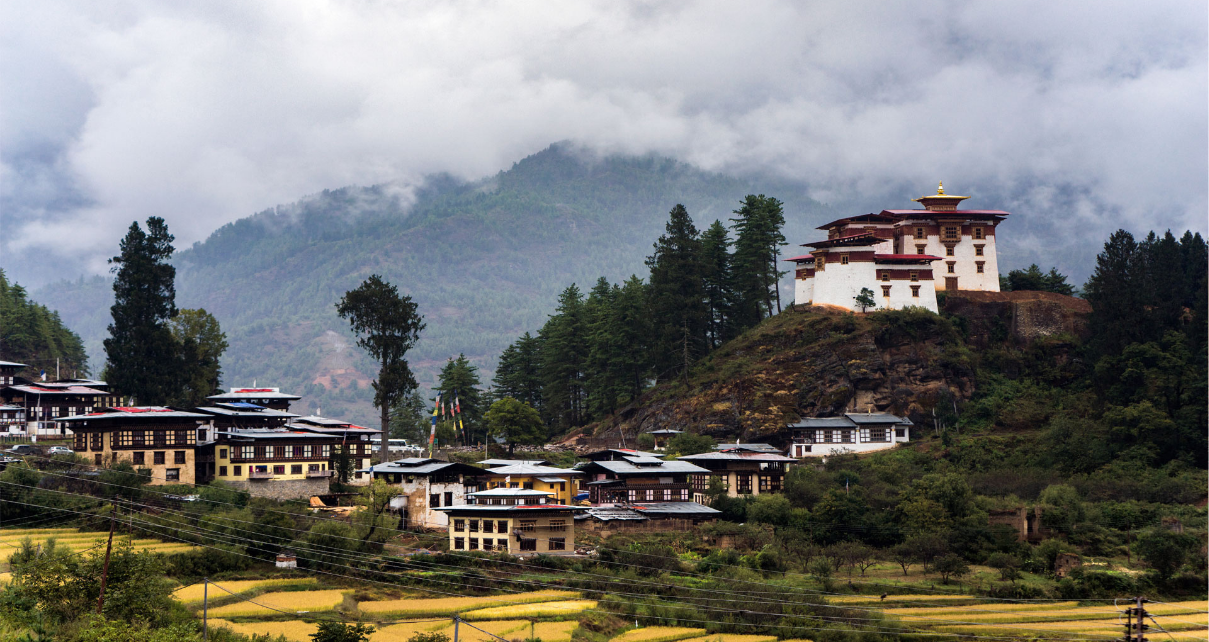
Bhutan is small by Himalayan standards roughly the size of Switzerland but it carries a presence entirely out of proportion to its geography. The valleys are deep and unhurried. The monasteries cling to cliff faces as if they grew there. The air, even in the capital Thimphu, carries the faint scent of pine and incense. And everywhere, the architecture follows rules set by the state: no building may contradict the traditional Bhutanese style, no facade may be left undecorated.
It is, in the truest sense, a country that has chosen to remain itself.
Why Bhutan Is Unlike Any Destination You Have Visited
Bhutan's approach to tourism is unlike that of any other country in the world. Where most destinations compete for visitor numbers, Bhutan has, for decades, pursued the opposite: a deliberate policy of restraint, grounded in the philosophy of Gross National Happiness the idea, codified in law, that national progress should be measured not only by economic output but by the wellbeing of its people, its culture, and its environment.
This is not a marketing concept. It shapes everything from how schools are run to how forests are managed. Bhutan is constitutionally required to keep at least 60% of its land under forest cover; at present, it hovers closer to 71%. It also shapes how visitors are received.
Tourism here is managed carefully. Until 2022, every foreign visitor paid a daily royalty that funded free healthcare and education for Bhutanese citizens. The system has since evolved into the Sustainable Development Fee, currently set at USD 100 per person per night, which continues to fund the same national priorities while regulating the pace at which visitors arrive. It is, in effect, a mechanism that ensures the country you come to see remains the country it has always been.
What is the Sustainable Development Fee (SDF) in Bhutan?
The Sustainable Development Fee is a mandatory daily charge of USD 100 per person per night, payable by all international visitors to Bhutan. It is separate from accommodation, meals, and guide costs. The fee funds public services including healthcare and education, and forms part of Bhutan's high value, low impact tourism policy. It is not a charge to be resented; it is, arguably, what keeps Bhutan the way it is.
What to Expect on the Ground ?
First time visitors often arrive with the expectation of a certain asceticism — remote, perhaps austere, a place of spiritual simplicity. What they find, particularly at the upper end of the market, is something rather more nuanced.
Bhutan has attracted some of the world's finest hoteliers. Aman's properties, Amankora, operate across five valleys and remain the benchmark for luxury here, combining traditional rammed earth architecture with the quiet precision that Aman has made its signature. Six Senses, too, operates lodges at Paro, Thimphu, Punakha, Gangtey and Bumthang, each one designed in sympathy with its surroundings; each one an argument for the idea that luxury and restraint are not opposing forces.
Meals are unhurried affairs, drawing on Bhutan's distinctive cuisine — ema datshi, the national dish of chillies and cheese — which will surprise most palates on first encounter and convert many of them, alongside international menus tailored to guests. Spa offerings draw on traditional Bhutanese healing practices, including the hot stone bath: a ritual in which river stones heated in fire are placed in a wooden tub of water infused with medicinal herbs. It is one of those experiences that sounds straightforward until you are in it, at which point it becomes quietly extraordinary.
"Bhutan is not a place you visit. It is a place that visits you, and the better prepared you are, the more it gives back."
Where to Go: The Five Valleys
Most itineraries move through a sequence of valleys, each one distinct in character. Understanding what each offers helps you decide how long to spend in Bhutan and where to focus your time.
Tiger's Nest: A Measured Assessment
No honest guide to Bhutan can sidestep the question of Tiger's Nest. Paro Taktsang, the monastery perched on a sheer cliff face at 3,120 metres, is the image most people carry before they arrive, and it does not disappoint. But it is worth knowing what the experience actually involves.
The hike from the car park to the monastery takes between 90 minutes and two and a half hours depending on pace and fitness. The altitude is meaningful; those who live at sea level will feel it. There is a well positioned café roughly halfway up where you can pause, collect yourself, and take in the view, which is, at that point, already extraordinary.
A good guide makes a considerable difference here. The monastery itself is a living place of worship, and understanding its history — Guru Rinpoche is said to have flown to the cliff face on the back of a tigress, meditating in a cave for three months — transforms what might otherwise feel like a physical achievement into something genuinely moving.
For those who prefer not to hike, horses can be arranged to the café level. Beyond that point, the path is on foot only.
How difficult is the Tiger's Nest hike in Bhutan?
The hike to Tiger's Nest Monastery (Paro Taktsang) is moderate in difficulty — approximately 5 to 6 kilometres return, with an ascent of around 900 metres. It takes most travellers between 90 minutes and two and a half hours to reach the monastery. Horses are available to the halfway café. No specialist trekking experience is required, but a reasonable level of fitness and comfortable walking footwear are advisable. The altitude — 3,120 metres at the monastery — is the primary consideration for those unaccustomed to elevation.
Practical Matters Worth Knowing
Getting There
Bhutan is served by Druk Air and Bhutan Airlines, with connections through Bangkok, Singapore, Delhi, Kolkata, and Kathmandu. From the UK, most travellers connect via Delhi or Doha. The descent into Paro airport is, by any measure, one of the more theatrical arrivals in aviation — the aircraft threads between mountain peaks before the valley suddenly opens and the runway appears. Pilots must be specially certified to land here. It is worth a window seat.
Visa and Entry
British passport holders require a visa to enter Bhutan. Visas are processed exclusively through a licensed Bhutanese tour operator or an international agent working with one, which means that independent travel, in the conventional sense, is not permitted. All visits must be arranged through an approved tour operator. The visa itself is a straightforward process when handled by your travel specialist.
Currency and Payments
The Bhutanese ngultrum is pegged to the Indian rupee. Most luxury lodges operate on a largely cashless basis, but it is worth carrying some local currency for markets and smaller purchases. Indian rupees up to the Rs 100 denomination are widely accepted.
Health and Altitude
Paro sits at around 2,200 metres; Gangtey and Bumthang are higher still. Mild altitude symptoms — light headedness, disrupted sleep — are not unusual in the first day or two. The simple remedies apply: hydrate well, take the first evening slowly, and resist the instinct to fill every moment on arrival. Your guide will pace you wisely.
How Long Should You Spend in Bhutan?
The honest answer is: longer than you think you need. Most first time visitors are tempted by seven or eight nights; those who return almost always started with fewer. Ten to twelve nights allows a comfortable journey through Paro, Thimphu, Punakha, and Gangtey, with time to breathe, to sit with the landscape, and to let the country reveal itself at something closer to its own pace.
Bhutan also pairs exceptionally well with Nepal and northern India. A journey that begins in Delhi, moves through the Golden Triangle, continues into Kathmandu and Pokhara, and concludes in Bhutan, is one of the great overland narratives available to the modern traveller and one that Bluebird designs regularly for our clients.
Can you combine Bhutan with India and Nepal in one trip?
Yes, and it is one of the most rewarding itinerary combinations in the region. A well structured journey might cover the Golden Triangle in northern India, followed by Kathmandu and Pokhara in Nepal, concluding in Bhutan. The contrast between the three countries — India's vivid complexity, Nepal's mountain grandeur, and Bhutan's serene self containment — makes each destination richer in the context of the others. A trip of this scope typically requires 18 to 22 days to do properly.
One Final Thought
There is a quality of attention that Bhutan seems to require of its visitors — a willingness to slow down, to look properly, to let an experience settle before moving on to the next one. It is not a destination that rewards the itinerary built for maximum coverage. It rewards those who arrive with some space already cleared.
For a certain kind of traveller — curious, thoughtful, already comfortable with the world's more obvious pleasures — Bhutan offers something genuinely difficult to find elsewhere. Not spectacle, exactly, though there is plenty of that. Something quieter. The sense that the world still contains places that have chosen to remain on their own terms.
That, more than any monastery or mountain view, is what people come home talking about.
When to Visit?
| Season | Months | Conditions & Highlights |
|---|---|---|
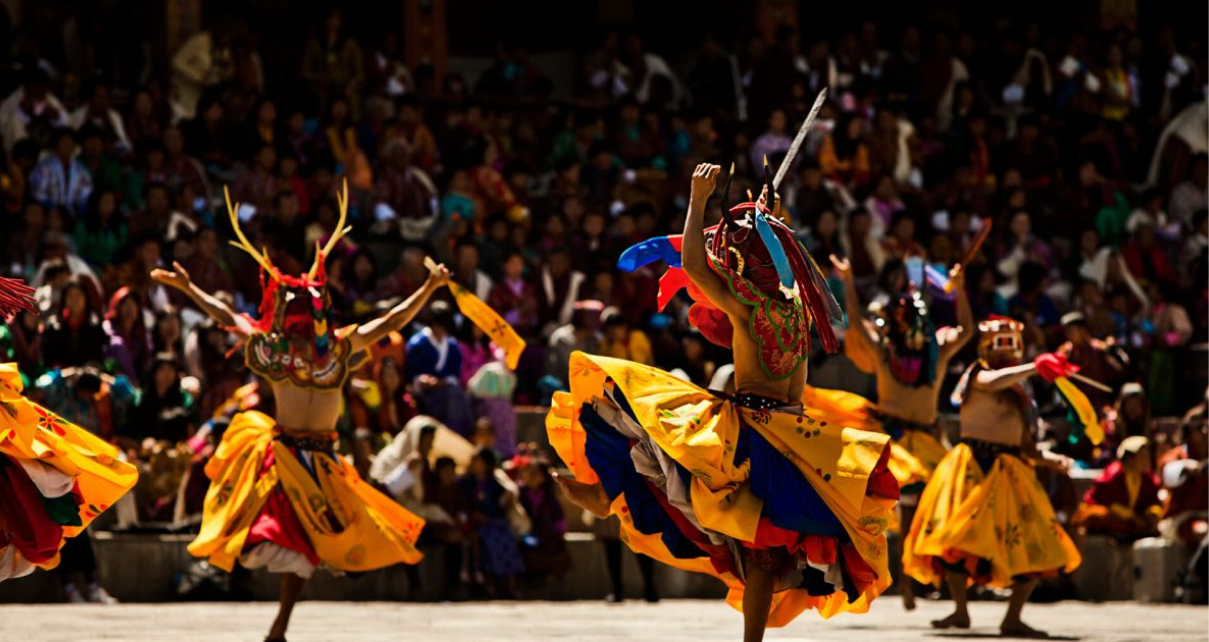
| Spring | March – May | The finest season for most travellers. Rhododendrons in bloom, clear mountain views, warm valley temperatures. The Paro Tsechu festival falls in spring, one of Bhutan's most celebrated cultural events. |
| Autumn | Sept – November | Equal to spring in many respects. Crystal skies, cooler air, and the harvest season lend the valleys a particular richness. The Black Necked Crane Festival in Gangtey typically falls in mid November. |
| Summer | June – August | Monsoon season. Bhutan receives heavy rainfall, particularly in the south. The landscape is lush and dramatically green. Hiking can be challenging, but the valleys are largely free of other visitors and lodges offer notable availability. |
| Winter | Dec – February | Cold, particularly at altitude, but skies are often brilliantly clear. Fewer visitors, excellent lodge availability, and a meditative stillness settles over the country. Punakha and Paro remain accessible. Not suited to those sensitive to cold. |
Where to Stay
Bluebird's Recommended Luxury Properties
- Amankora Five lodges across five valleys; the gold standard of luxury in Bhutan
- Six Senses Bhutan A multi lodge journey concept with exceptional wellness programming
- Como Uma Paro Intimate and beautifully positioned, with outstanding Bhutanese cuisine
- Gangtey Lodge Perched above the Phobjikha Valley; spectacular at crane season
- Zhiwa Ling Ascent A more intimate Paro alternative with strong cultural character
- Pemako Punakha Design led and immersed in the river valley; a newer entry worth knowing

